
Compared
Cheaper machines, or less to operate.
Fly.io wins the price comparison on most lines. Whether that settles it depends on how much operating you want to do.
The short answer
Fly.io is the cheapest platform in this set for small workloads: a shared-CPU machine with 256 MB is around $2 a month, and egress is $0.02 per GB against Dockup's $0.09. Dockup costs more and hands back more — managed databases as a first-class object, Windows and Linux VMs, deployment to servers you already own, and a CLI built to be driven by an agent.
Line by line
| Compared on | Dockup | Fly.io |
|---|---|---|
| Smallest machine | ≈ $15.20 metered · 0.5 vCPU, 512 MB | ≈ $2.02 · shared-cpu-1x, 256 MB |
| Egress | $0.09 / GB | $0.02 / GB in NA and Europe |
| Volume storage | $0.10 / GB-month | $0.15 / GB-month |
| Dedicated IPv4 | Included | $2 / month |
| Paid support | Included | $29 / month for Standard |
| Managed databases | PostgreSQL, MySQL, MongoDB, Redis | Postgres is a Fly app you operate |
| Windows VMs | Yes | No |
| Deploy to servers you own | Yes, over SSH | No |
| Global regions | Regional | Many, and the core of the product |
Fly.io figures are their published list prices, checked on 22 August 2026. They change without notice — verify before deciding. Ours are on the pricing page, per unit, so you can redo this arithmetic yourself.
Where the price difference actually comes from
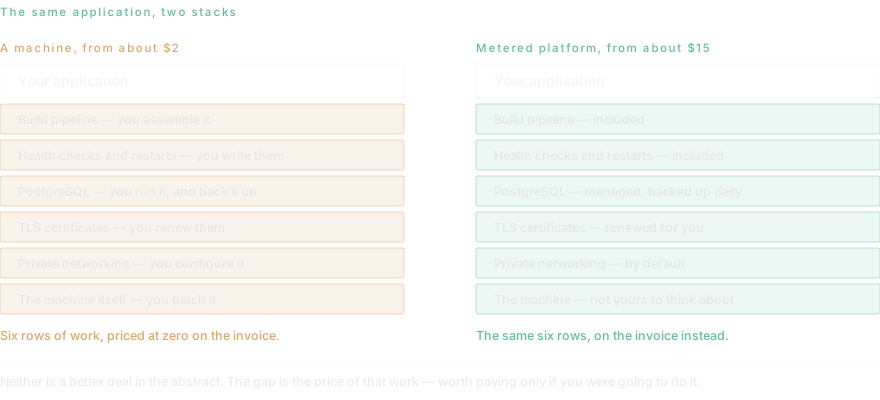
Fly.io machines start around $2 a month and that number is real, but it is buying a different thing. A Fly machine is closer to a small virtual machine you operate: you choose the regions, you run Postgres yourself unless you attach a managed one, and more of the operational surface stays yours.
Metered container platforms cost more per unit and include the parts you would otherwise assemble -- the build pipeline, the health gate, the managed database, the certificate renewal. Neither is a better deal in the abstract; the gap between them is the price of the work, and it is worth paying only if you were going to do that work.
When global regions are worth it, and when they are not
Fly's real advantage is putting the same application close to users in several places at once, and for a latency-sensitive product with a worldwide audience that is difficult to match.
For most applications it is not the bottleneck. If the database lives in one region, requests still cross the ocean to reach it, and multi-region compute in front of single-region data buys less than it appears to. Measure where the latency actually is before paying to move the compute.
Choose Fly.io if
- Price is the deciding factor and your workloads are small. Nothing here beats $2 a month for a running machine.
- You serve a lot of traffic globally. $0.02 per GB of egress and machines close to users is the product Fly is actually selling.
- You are comfortable operating your own Postgres. Fly Postgres is an app you run, not a service someone else keeps alive.
Choose Dockup if
- You want the database to be somebody else's problem — provisioned, backed up daily, restorable to a new instance, on a private network with no public hostname.
- You need Windows, or a Linux VM with root, in the same account.
- You have your own servers that must stay, and want the same deployment tooling pointed at them.
- Support being included rather than $29 a month matters at your size.
Questions this page gets asked
Is Fly.io cheaper than Dockup?
On raw compute and egress, clearly yes — a small shared-CPU machine is around $2 a month against roughly $15 metered, and egress is $0.02 against $0.09 per GB. Dockup is cheaper on volume storage, includes a dedicated IPv4 and includes support that Fly charges $29 a month for.
Does Fly.io have managed databases?
Fly Postgres is an application you run on Fly rather than a managed service — you are responsible for it. Dockup provisions PostgreSQL, MySQL, MongoDB and Redis as managed objects with daily encrypted backups and no public hostname by default.
Which is better for a global application?
Fly.io, without much argument. Running close to users across many regions is the core of its product, and its egress pricing reflects that. Dockup is regional.
Is Fly.io cheaper than Dockup?
Per unit of compute, usually yes -- a small Fly machine starts around $2 a month. It is buying something different: you operate more of it, including Postgres unless you attach a managed instance. The gap between the two prices is the price of the build pipeline, the health gate, the managed database and the certificate renewal.
What is Fly.io best at?
Running the same application close to users in several regions at once. For a latency-sensitive product with a worldwide audience that is hard to match, and it is the reason to choose Fly rather than the price.
Does Fly.io have managed databases?
Managed Postgres is available, and for a long time the common path was running Postgres on Fly machines yourself. That is the operational difference in one line: on a managed platform the database arrives provisioned, backed up daily and on a private network without a public hostname.
Can I run Windows or a full Linux VM on Fly.io?
No -- Fly runs containers as micro-VMs, not general-purpose machines you log into. If the workload needs root on a real Linux box, or Windows over RDP, that is the line where the comparison stops being about price.
Compare something else
- Dockup and Railway
- Dockup and Render
- Dockup and Vercel
- Dockup and Heroku
- Dockup and Netlify
- Heroku alternatives
- Vercel alternatives
- Railway alternatives
- Netlify alternatives
- Supabase alternatives
- Firebase alternatives
- DigitalOcean alternatives
- Coolify alternatives
- Render alternatives
- Dokploy alternatives
- Railway and Render, compared
- How a migration actually goes
Try it against your own workload.
The free plan grants $10 of infrastructure credit at signup, needs no card, and does not sleep.