
Alternatives
Heroku alternatives, with prices attached.
Heroku removed its free tier in November 2022. Most people arriving here are looking for the cheapest thing that still feels like Heroku.
The honest summary: several of these are cheaper than Heroku and none of them has its add-on marketplace. What follows is what each is actually good at, including the ones that beat Dockup.
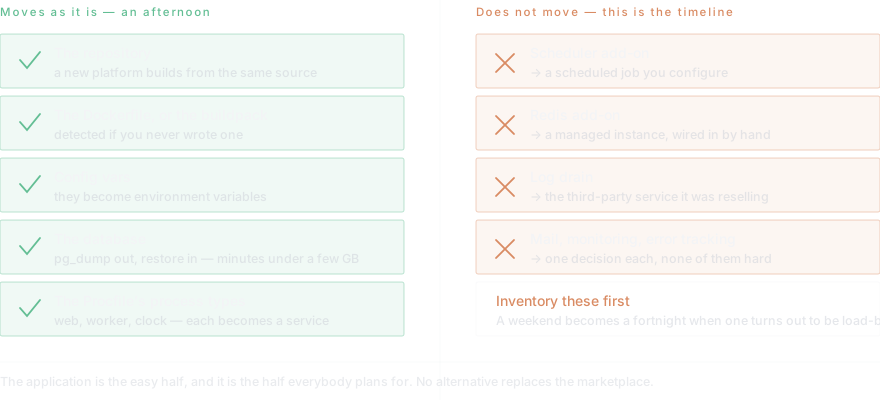
What actually costs you when leaving Heroku
The application is the easy half. It is already in a repository, it already has a Procfile or a Dockerfile, and any platform on this page will build and run it. Budget an afternoon for that part and you will usually be early.
The expensive half is the add-on marketplace. Heroku made it trivial to attach Redis, a scheduler, a mail sender, log drainage and monitoring, each with a one-line config var. None of the alternatives replaces that catalogue, so every add-on becomes a separate decision: a managed equivalent, a third-party service, or a piece of your application you now maintain.
The realistic advice is to inventory the add-ons before you compare platforms at all. A migration that looked like a weekend becomes a fortnight when the scheduler and the log drain turn out to be load-bearing.
What a small app costs after the move
A single always-on web process with a small Postgres is the shape most people are moving. On Render that is $7 for a Starter instance on a free workspace plus the database. On Railway or Dockup it is metered, which lands near $15 for the same shape and less if the service idles. On Fly.io a small machine is around $2 and you operate more of it.
Heroku's own equivalent starts at $5 for an Eco dyno, which sleeps, or $7 for Basic, which does not. So the honest summary is that leaving Heroku is rarely about the dyno price -- it is about the add-ons, the sleeping, and the sense that the platform stopped being invested in.
Does anything here replace the Heroku add-on marketplace?
No, and any page that tells you otherwise is selling something. What the alternatives do instead is include a smaller set of the things people actually attached: a managed database, TLS certificates, private networking, scheduled jobs.
For the rest -- error tracking, log search, mail -- you end up at the same third-party services the add-ons were reselling, wired in directly. That is usually cheaper and always more work to set up once.
Questions this page gets asked
What is the cheapest Heroku alternative?
Fly.io for raw machines, at around $2 a month for a small one. Among managed platforms, a $7 Render instance on a free workspace. Dockup has the only free plan in this list that does not sleep.
Which alternative is most like Heroku?
Render, in feel and workflow. None of them replaces the add-on marketplace, which is usually the real migration cost rather than the application itself.
Is self-hosting cheaper?
The bill is, and the total is not, unless your time is free. Coolify and Dokploy are excellent at what they do; you are still the person who gets paged when the disk fills.
Is there a free Heroku alternative?
Several, with a catch worth knowing. Free tiers in this category usually sleep after a period of inactivity, which is fine for a demo and wrong for anything a user reaches. Dockup grants $10 of infrastructure credit at signup and does not sleep; Render offers free static sites and a free workspace, with the cheapest always-on service at $7.
How long does it take to migrate off Heroku?
An afternoon for the application itself -- it deploys from the same repository and the config vars copy across as environment variables. The database is a pg_dump and a restore. What extends the timeline is the add-ons: every scheduler, log drain and mail sender is a separate replacement decision, so inventory them before you start.
Will my Procfile still work?
Not directly on most alternatives, but what it describes translates cleanly. Each process type -- web, worker, clock -- becomes its own service or scheduled job. The commands are the same; only the file that declares them changes.
Is Heroku still worth using?
For a team already on it, with add-ons wired in and a bill nobody is fighting, moving costs more than it saves. The reasons people leave are the removal of the free tier in November 2022, Eco dynos sleeping after 30 minutes of inactivity, and the sense that the platform stopped growing. None of those is an emergency on its own.
Compare something else
- Dockup and Railway
- Dockup and Render
- Dockup and Vercel
- Dockup and Heroku
- Dockup and Fly.io
- Dockup and Netlify
- Vercel alternatives
- Railway alternatives
- Netlify alternatives
- Supabase alternatives
- Firebase alternatives
- DigitalOcean alternatives
- Coolify alternatives
- Render alternatives
- Dokploy alternatives
- Railway and Render, compared
- How a migration actually goes
Try it against your own workload.
The free plan grants $10 of infrastructure credit at signup, needs no card, and does not sleep.