
Compared
Railway or Render: the difference is how they bill you.
Both deploy a container from a Git repository and both do it well. They part company at the pricing model, and that is what should decide it.
The short answer
Pick Render if you run one or two small services that are always on and you want a bill you can predict: $7 for a Starter instance on a free workspace is the cheapest managed always-on service in this category, and nothing about it is metered. Pick Railway if your workload is bursty, if you want the template library, or if you move a lot of data out — its egress at $0.05 per GB is the lowest of the three platforms on this page. The pattern to watch for on Render is the $25 workspace fee arriving before you have enough services to spread it over.
The features overlap almost completely. Both build from a repository, both give you managed PostgreSQL, both do preview environments, custom domains and automatic TLS. Choosing on a feature checklist will not separate them, which is why most comparisons of these two are unsatisfying.
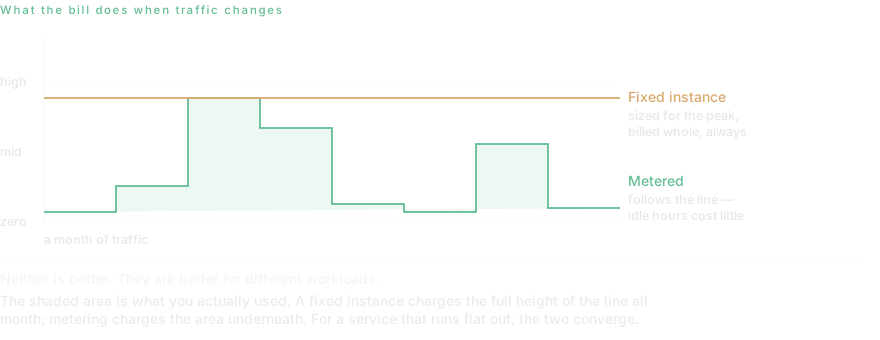
The real difference is the billing model, and it is not a detail — it changes what your bill does when your traffic changes. Railway meters compute and memory by the second, so an idle service costs close to nothing and a busy one costs more. Render sells you an instance of a fixed size for a fixed monthly price, so an idle service costs exactly what a busy one does. Neither is better in the abstract; they are better for different workloads.
Line by line
| Compared on | Railway | Render | Dockup |
|---|---|---|---|
| Entry paid plan | $5 · Hobby, $5 usage credit | $0 · Hobby workspace | $5 · Hobby |
| Workspace fee on the team plan | $20 per workspace, $20 credit | $25 · Pro | $20, first $20 usage included |
| How compute is billed | Metered, $0.02779 / vCPU-hour | Fixed instance size | Metered, $0.02778 / vCPU-hour |
| Small always-on service | ≈ $15 metered | $7 · Starter instance | ≈ $15.20 metered |
| Medium service, 2 GB | ≈ $40 metered | $25 · Standard instance | ≈ $40.52 metered |
| A service that idles most of the day | Cheap — you pay for the hours used | Full price — the instance is billed whole | Cheap — metered per minute |
| Egress | $0.05 / GB | $0.15 / GB | $0.09 / GB |
| Persistent storage | $0.158 / GB-month | Included with disks | $0.10 / GB-month |
| Custom domains | Included | $0.25 per domain per month | Included, with TLS |
| Charged per team member | No | No | No |
| Template library | Very large | Moderate | Small |
| Linux or Windows VMs | No | No | Yes |
| Deploy to servers you own | No | No | Yes, over SSH |
Railway and Render figures are their published list prices, checked on 22 August 2026. They change without notice — verify before deciding. Ours are on the pricing page, per unit, so you can redo this arithmetic yourself.
Choose Railway if
- Your traffic is uneven. Metering is worth real money on a service that is busy for three hours and idle for twenty-one.
- You move a lot of data out. At $0.05 per GB, Railway has the cheapest egress of the three and it compounds quickly.
- You want to start from a template. Railway has thousands, and being able to click a working Postgres-plus-worker stack into existence is a genuine head start.
Choose Render if
- You want to know the number before the month starts. A fixed instance does exactly that, and for a service that is always on it is usually cheaper than metering the same shape.
- You run one small always-on service. $7 on a free workspace is the cheapest managed option on this page, and neither of the others beats it at that size.
- You are coming from Heroku. Render is the closest in feel and workflow of anything in this category.
Choose Dockup if
- You need a machine rather than a container — Linux with root, or Windows over RDP. Neither Railway nor Render runs one.
- You have servers of your own that have to stay in the picture. Dockup deploys to them over SSH and keeps the output, timings and exit codes.
- You store a lot and move a little. Storage at $0.10 per GB-month is the lowest of the three, which goes the opposite way from Railway’s egress advantage.
- You drive deployments from a coding agent and want structured JSON and real exit codes instead of prose to parse.
Questions this page gets asked
Is Railway or Render cheaper?
Render, for a small service that is always on — $7 for a Starter instance on a free workspace, against roughly $15 metered on Railway for the same shape. Railway gets cheaper as the workload becomes uneven, because you stop paying for idle hours, and its egress is a third of Render’s at $0.05 against $0.15 per GB.
What is the difference between Railway and Render?
Billing model, mostly. Railway meters compute and memory by the second; Render sells fixed instance sizes for a fixed monthly price. The feature sets overlap almost entirely — both build from Git, both offer managed PostgreSQL, preview environments and automatic TLS.
Does Render have a free tier?
A free workspace, yes, and free static sites. Free web services sleep when idle, which is fine for a demo and not for anything a user might hit. The cheapest always-on service is the $7 Starter instance.
Which is better for a side project?
Render, if it is always on and you want a predictable $7. Railway, if it runs occasionally, because metering means an idle project costs almost nothing. Dockup’s free plan grants $10 of infrastructure credit at signup and does not sleep, which is a third answer worth knowing about.
Can I move between them later?
Yes, and easily in both directions — the application is in a Git repository and neither platform holds it hostage. What actually takes the time is the database and the environment variables, which is true of any move between any two platforms in this category.
Where does Dockup fit?
Same metered model as Railway, to within a hundredth of a cent on compute, with cheaper persistent storage and dearer egress. What neither of the others does is run Linux and Windows virtual machines, or deploy to servers you already own. If you only need containers, this is a comparison between Railway and Render and we are a footnote in it.
Compare something else
Try it against your own workload.
The free plan grants $10 of infrastructure credit at signup, needs no card, and does not sleep.